Regenesis Interview
You wouldn’t treat your friends as a disposable commodity.
Regenesis believes that you should not treat the goods you buy like this either. Real sustainability means caring about where products come from and how they were made. But this shouldn’t always mean paying more.
Find out how circular economies have the potential to protect the environment and save you money.
Listen here or find us on your favorite podcast app.
December 22, 2020
Time’s Up for Single-Use Items
#78 Great.com Talks With... Regenesis
Living sustainably does not have to leave us out of pocket. In this episode we talked with Erin Cochrane and Tristan Laing from Regenesis about creating scalable grassroots programs that change the way we think about sustainability.
How Free Stores Benefit Consumers and the Environment
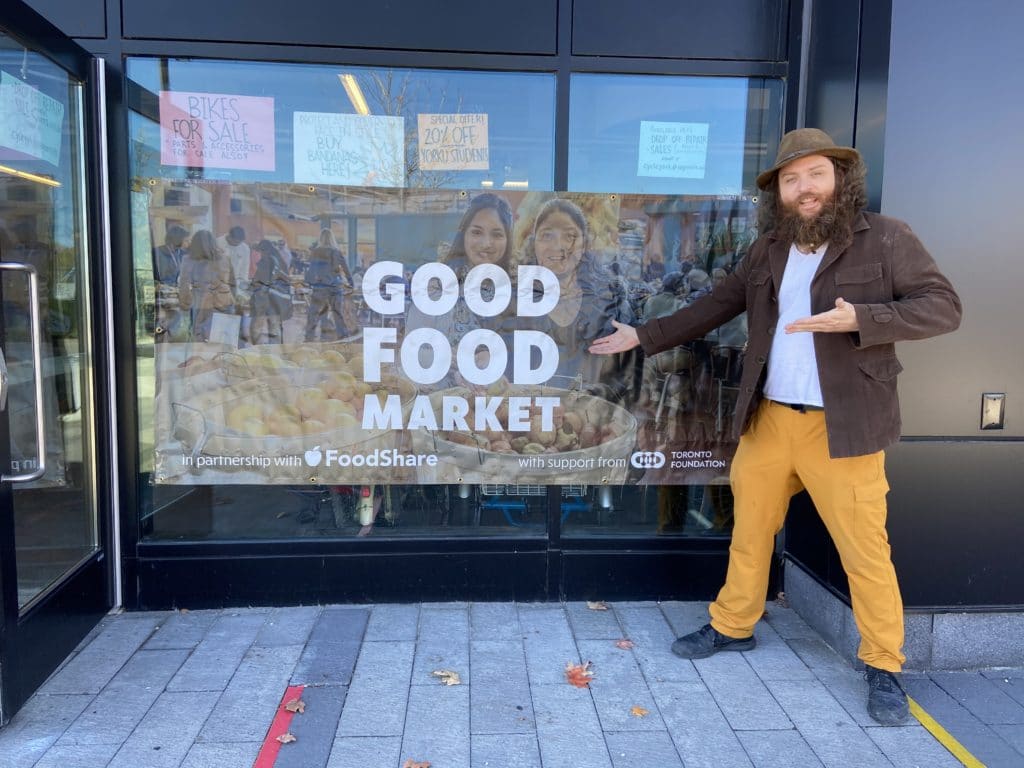
'Sustainable' has become a marketing buzzword used by retailers to charge a premium. But Regenesis runs a number of student-focused outlets in Toronto that are both environmentally friendly and affordable. Their free stores, farmers' markets and borrowing centers are creating a a circular economy on University campuses. Instead of being discarded, products are lent, re-used or donated to extend their life-cycle. Erin and Tristan explain how this form of consumption can help consumers become more conscious of the supply chains behind the products they use, and able to make ethical choices.
Listen to the whole interview to find out more about community and individual empowerment. You can also read about local chapters such as Regenesis York and programs such as York Farmers' Market.
Want to learn more about Regenesis? You can read about their latest events and follow them on Facebook, Instagram and Twitter.
Great.com's main goal is to generate money by bringing you the best online casino reviews. They then donate that money to the most influential causes driving change in the world. You can read our reviews and take a quick look at some of the most popular online casinos in New Jersey and online casinos in Sweden.
[00:00:00]
Every day you and I get bombarded with negative news. Feels like the body becomes what reads the mind, because what we’re putting in it is important to listen to stories that not only gives you hope, but also inspires you and uplifts you. In this podcast, we’re interviewing experts who will break down the solutions to the world’s most pressing problems. And I promise you, if you listen to this podcast, you’ll not only stay informed, but you’ll also feel more energy. Welcome to great dotcom talks with.
[00:00:43]
Great dotcom is a philanthropic project where we’re donating 100 percent of our profits to fund the most effective coursers in the world, like protecting the rainforest and funding climate change technology. And the topic of today in this interview is the power of student communities to solve the climate crisis.
[00:01:03]
We’re going to talk about the climate and the communities and the power of the students.
[00:01:10]
So to understand more about this, we have invited the organization, Regenesis, and specifically we have two guests with us today.
[00:01:18]
The first one is Aaron Cole, Train Cochran. And welcome to this podcast. Thank you so much. Did I spell your name correctly, Cochran and the second guest is Treston Line. Help me pronounce that one.
[00:01:43]
That’s perfect.
[00:01:45]
Perfect, Tristan and Erin, welcome.
[00:01:49]
I want to start with you, Aaron, task, when you look at the world, what kind of problems that you would like to help solve and what is it trying to solve with being a part of Regenesis?
[00:02:05]
The first part of that question, what problem are we trying to solve or what problem do we see is that there is a multiplex of very challenging issues when we look at sustainability and that word’s become such a hot word, it’s very trendy.
[00:02:29]
But what does it mean? And what we look at as sustainable isn’t necessarily sustainable. We look at sustainable development and development in and of itself can be very contradictory to sustainability. So what Regenesis tries to do is to look at how we can modify, modify, reduce, reuse, change our mentality and really address the underlying causes of why human life is unsustainable right now. So looking at things from a very systemic approach of understanding the history of the current sustainability challenges that we’re facing right now and how to build individual and community empowerment around that. So the problem that we see that we’re facing is that our day to day actions, as much as they’re small, a lot of the time contribute to the global problem. So how do we change day to day action?
[00:03:40]
And Tristan, if you would get the same question about what problem do you see in the world and also help us to bridge towards Regenesis, how that’s how the organization fits in to solve a problem, what would be your answer?
[00:03:57]
Yeah, so, um, so we’re just this is a student based and student focused organization, right? So, like what I like , I was a student for many years. I’m no longer a student. But what is the situation of students with respect to the climate crisis and other ecological crises that it’s something like. They’re. There are the most impacted, I mean, except for people who are even younger, perhaps in the sense that there is going to be living through these crises for the longest, the longest period of time. So they have the most interest really in really dealing with it. They also have that in a certain sense, they have the most resources to do some in the sense of time like they have their whole lives. But also they have the fewest, not the fewest, but like on the lesser side of resources, in the sense that, you know, students are almost by definition, students are experiencing transitional poverty and students are under incredible amounts of stress, definitely financial stress. If you look at your government transfers to education have decreased steadily over the past generation about about one one and a half generations. So tuition has been going up. The cost of living has been going up and the time squeezed. Right. So the amount of time because of the financial constraints, like more and more students have to work part time or full time during their studies. When I was at UBC in the early 2000s, I only knew a handful of people who had part time jobs.
[00:05:26]
Now, skills like when I was teaching a couple of years ago on campus, it felt like almost all of my students were working. So the amount of time that students have has really decreased. So. So like. Students are like that, they need to be able to have this kind of like, clear view of the future that they’re going to live through, and that means, like, obviously it means things for their everyday lives. Obviously, like we all want to live eco friendly lives, but we also don’t want to just live eco friendly lives in a kind of individualistic way because, you know, capitalism is very willing to sell us. Like I saw on the other day on an advertisement in Metro grocery stores. Is selling guilt free soda like, no, no, we don’t all need to, like, pay more for soda to expunge our guilt. This is the problem with this. And there’s a lot of problems with this strategy. But one of the problems is, is basically a dead end because it’s a supplement rather than a transformation. So it’s not enough just to tell people, especially students who have low financial resources, that they need to spend more money to buy eco friendly products. It’s like this is not that’s not what Regenesis does. Regenesis is about students working together with some non students to help to create new systems so that they can live in a more eco friendly way, also in a way that doesn’t expunge their financial resources.
[00:06:52]
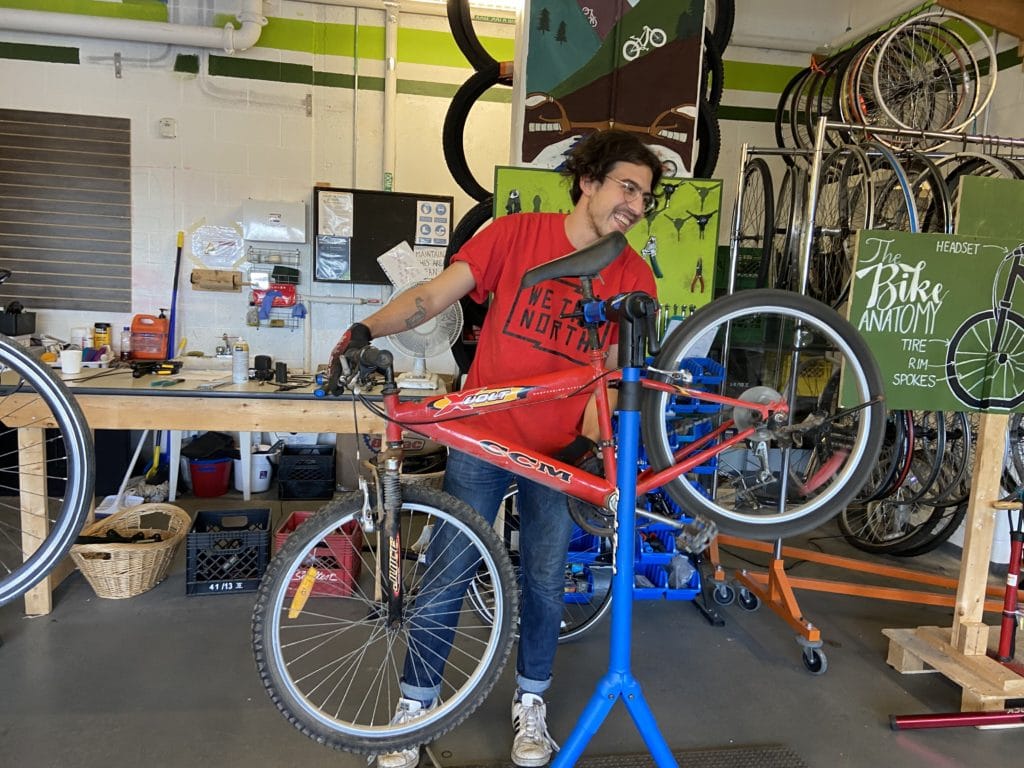
So we set up what we call environmental initiatives and all of them, all of our environmental initiatives, which are essentially forms of social enterprise, allow people to access the material goods they need to live their lives in a way which is eco friendly, but also crucially in a way which is as or more affordable than the kind of standard alternative they would engage in. So it will talk more about these, but these would be things like our free stores are boring, centers are bike centers, are farmer’s markets. All of these have to have a focus on greater affordability. And this is actually really crucial because it means that we’re not just kind of competing on the market for resources and we’re like, oh, buy more of our things because then you’ll be more eco friendly. But like you but sort of taking the amount of resources that people have as a given, we’re trying to essentially make. Students are richer in the sense of having more resources, because they can acquire these things at a lower cost or or at a non cost. So that’s why. So it is about individual transformation, changes in changing people’s lives, but in the context of building new systems. And that’s really I think the Regenesis difference is we’re trying to do on the ground like student initiated systems change.
[00:08:13]
And you both speak about we need a system change. Erin, you were into that as well. And you’re mentioning some specific initiatives. And I was into the website and I saw one of those which you just mentioned, the free stores or free. Now, the Freestore, which kind of blew my mind if the correct people would donate to these stores and then people could just have a need, they could get it for free from this place. And if that is the idea, just like to stay a little bit on that specific project. Erin, could you help us understand that what’s going on and tell us more about the initiatives, the specific ones?
[00:08:58]
Yeah, actually, so you are correct, that is what is happening, so as Treston really amazingly elaborated, part of what Regenesis wants to do is not just to create the opportunity for new behaviors to happen in a more ecologically friendly way, but to also provide. An affordable solution, because we’ve kind of price tagged this idea of sustainability, that you have to pay more to live a more sustainable life. And redundancy means we want to dismantle that misconception by recognizing that we can engage in the circular economy in a totally different way. So that’s the idea of something like our free store, which for students that are involved in the campus being our primary audience and the community that we service, we accept donations from community members, from students, from staff, professors, anyone in the community, really. And then we offer them back to students for free. So it really does. The idea of the circular economy is that we decrease the amount of production by re utilizing, repurposing and dispersing the resources that we already have. We have this enormous plethora of things and items that people go through on an overly continuous basis. So how do we reduce consumption and production and transform that into filling a need with other needs and not so yet just reducing the amount of.
[00:10:46]
Of single use or a low short term use of product by expanding, extending the life cycle of a product so that it can continue to be used.
[00:10:56]
So things like clothing, furniture, books, tools, stuff like that, so students can then also access these things. As Treston pointed out, students oftentimes are in states of transition. So they’re going through an enormous amount of getting rid of things, purchasing new things. So we figured it was a perfect place to create this circular economy market where students are able to benefit through the transition period that they’re all going through, as well as provide some economic opportunity to not have to purchase these things individually. Every single time you move or leave school, things like that. So.
[00:11:37]
That’s the big free story specifically, are you getting to where the other initiatives, but that’s that’s every story.
[00:11:44]
I’m fascinated that I’m not. I’m attending many organizations who’re trying to help the government, and I’ve not heard that idea before, that it’s a misconception that we need to pay more to create a more sustainable system. So that is very interesting. I find it and I’m finding it. I know Gretta Sumberg, she was talking about the fossil fuel cap report saying that in the current capitalistic system we’re having we already signed up or more production than we can handle if we’re going to meet those climate agreement and goals so that the old system is not going to help deal with climate change. So we need a new system. And I guess that’s kind of what you’re offering here. So my question here would be Trystan. I guess we would need this on a quite big scale, so, well, what is the gap right now from how much have you already implemented and how much do we need to implement for this to start to work?
[00:12:57]
Well, I mean, I think that that’s. It’s not that that’s the wrong question, but that. This is not the kind of problem which small grassroots organizations can tackle, as if they are large central planners. We are not large central planners. We are a small grassroots organization. So when we think about when we think about the need to tackle the problem on a much larger scale, we think about how can the way the problem already appears within the kind of the current scale be responded to in a way that’s scalable? So for us, like it for us, scalability is the core concept. We don’t run any initiatives which are not scalable and what do we mean by scale? But we mean that in principle there’s no there’s no barrier between running like one or two right now. We’re kind of running low. I mean, during the pandemic, everything was kind of. A little bit hampered, but running maybe like one and a half free stores, but there’s no reason why this basic logic can’t be rolled out and have free stores at every single camp, university and college campuses across Toronto or across Canada. That’s also true for our food initiatives. A lot of our initiatives would actually mean, unsurprisingly, there would be some efficiencies to running at a greater scale. I think this is the core thing is that like things are going to change over our lifetimes, like one of the things that makes it difficult to run some of the initiatives now is actually has to do with how inexpensive certain kinds of goods are under capitalism.
[00:14:43]
So that the prevalence of dollar stores, for example, makes it just so easy and low, relatively low cost to acquire consumer goods. That’s why it’s one of the reasons why they get thrown out so much that won’t necessarily remain the same over our lifetimes. And as the costs of certain kinds of goods goes up, the amount of savings that will be available through our initiatives will also go up. And that’s why we think it’s so important to to develop these structures and to to kind of expand them as much as we can so that when the need when the when the need really starts to ramp up, especially around like the cost of groceries is going to go up over our lifetimes of thinking about our farmers markets and the way we work with food. Share the. Organizing initiatives where like, for example, so we run that, we run these we run these food market kind of things where we order the food through food share and then we sell it on to students and essentially no markup. So right now, that’s like a little bit more affordable than than the standard grocery stores. And it’s also much more sustainable because virtually all the food is not entirely organic, because we prioritize affordability over organic in this context. But it is regional, like it’s not it’s not food that’s coming from from too far away.
[00:16:06]
As the costs go up, the price differences between regional and food from far away will continue to increase. It will become and.
[00:16:19]
Yeah, essentially, what we’re moving towards is an economy where people are more intentional about the way they use their resources. So there’s always like an educational component to consumption with Regenesis initiatives. So it is a bit of a bit mumble, but essentially the answer is like building intention through an educational form of consumption and scalability. So like the indefinite extension, indefinite extensibility of all of the projects.
[00:16:52]
And education to educate on how to. Make decisions when you’re. Are you saying that a central.
[00:17:04]
It’s not I mean. Sure, it’s a. It’s really about becoming more conscious of the way that we are engaging with the world when we’re doing things like the thing that capitalism does is it decem, beds, trade and production from social morality. I mean, that’s that, that’s one analysis. That’s the kind of carpal tunnel if you and I think that’s correct. So it kind of tricks us into believing that, like when we’re engaging with our friends or even when we’re
engaging, like at school with our professors or like basically in any kind of socially regulated context, there’s a set of values. There’s a set of moral edicts which we have to observe. But as soon as we’re involved in some kind of exchange, all bets are off. So, so, so, so it’s so like to think about it. It would be considered atrocious to, like, treat a friend like very, very poorly. But it’s considered totally OK to purchase some food product or some manufactured product when you know very well the kind of the production chain and the kind of. The chain of events that resulted in you and you being able to purchase that product had a lot of violence in it. We think that that’s OK. And that’s really that’s really something that we as a species have to overcome.
[00:18:30]
So when I talk about, like consumption as a form of education, what I mean is like when you look when you consume something like becoming less alienated from that chain of production and distribution that brought it to you. So like and that doesn’t mean that immediately you have to know everything about how these raspberries got to your table. But starting to think about that, starting to understand that. And this is what affordability is very important because it’s not that capitalism doesn’t sell you, doesn’t sell us any versions of your farm to table or something, but it only sells us the version that’s expensive and is excluded, is excluded from your lower income people or from students. So that’s why we think it’s so important to be able to create alternatives where you can purchase products that are essentially. More ethically sourced and more ethically sourced, I mean, you can actually think about the sourcing, you can actually have a relationship with cause with the labor that produced you being able to have this. And that’s like I mean, it’s kind of like opening up and really you usually think about it this way, but it’s a kind of opening up of your heart to the world which capitalism closes off.
[00:19:41]
I think you’re implying that let me stay with that message. Capitalism is closing off a part of your or maybe the whole part of your hearts and. We would not do that to our friends, but whenever there is some transaction, it’s just different game rules and those game rules are allowing violence to happen in the chains of the production. Exactly. It makes sense when you say it like that. It’s interesting that that is not more. Now that. That is not more reflected in the system right now. Erin, I want to ask you about this kind of support. Or what would you like for people to do after hearing Cynthia? Now, what support does Regenesis need or.
[00:20:45]
I would consider that in a multipronged approach.
[00:20:52]
There’s.
[00:20:55]
Obviously, when you engage with any kind of information, it’s up to us as individuals to decide what to do with that information. Actually, Tristin, was it just I think just that is like one of my friends said so now what? So what is so so what now? I can’t remember what it’s like. So what you just learned is that you heard this thing. Now what that kind of relationship is with information that we have. So what I would ask from people who would listen to this interview is on a personal level.
[00:21:29]
Take a minute. Take a minute to think about.
[00:21:33]
What systems you engage with in your day to day life and take one minute to be mindful of it, to to meditate on it, to think about it, to have a conversation about it.
[00:21:48]
But that, for me, was the biggest step in the last few years of my life.
[00:21:53]
And learning more about how my own personal relationship with these ecological challenges is going to look like is slowing down.
[00:22:03]
And like Kristen was saying, starting to really recognize the life cycle that comes behind everything that we consume because there is a life cycle to everything that we consume. And so what I would ask would be for anyone who’s listened to this is to take a minute to think about that, because I think that’s that for me anyway, was the first
step. And that’s where we can start to initiate action and community building and engaging with more organizations that are doing this kind of work. And I think that that personal first step is really important from a Regenesis level.
[00:22:42]
I would say get involved with the programs, check out our website, see the kind of initiatives and the kind of work that we’re doing and how we’re building community and empowering individuals to get involved in this kind of work on campuses, especially if you’re a student.
[00:22:57]
We operate all across the GTA at multiple campuses, so we love getting more students involved at all levels, volunteers, chapter executives. So lots of different layers of leadership and engagement possibilities for students and also community members.
[00:23:13]
So you can always engage with any of our initiatives and get to take part in seeing what it feels like to make those kinds of decisions and what that action can look like.
[00:23:28]
So, yeah, definitely engage on a personal level, engage an organization level. And we also are going to be starting up a donation program. So keep your eyes open if you feel inclined to put some funds towards helping these initiatives continue to operate and paying students to empower their own future, be empowered in their future, then, yeah, we’re happy to accept all of those actions.
[00:23:54]
And I want to say thank you to you, I want to direct the last question to Tristan and then. So, Tristan, I want to give you the opportunity to either answer my question or if you feel that something is missing in this and you feel free to go for that question, I’m thinking about this. If I am a student or if I’m just having anxiety and I want to do something, what would you recommend people to?
[00:24:25]
To start looking for.
[00:24:30]
Yeah, I mean, I see, like get involved in something concrete, so obviously, like Aaron said, if you’re in the GTA, you get involved in our chapters, like help us start a new chapter on a new campus, please. That would be great. If you do that, then you get to work with Aaron and I because like we’re the main education, people will give you your handbook. You’ll get to come to the retreat. It’s going to be a campfire. It’s going to be so much fun if you’re not in the GTA. Well, if you’re a university, like even even if you’re on the GTA, we can help. We can support chapters elsewhere in Canada. But like, if you’re in England or something like probably we can. So like so but the thing is, that’s OK, because there’s probably something else going on in your town. And there’s got to be there’s stuff like this going on in the broadest sense. There’s stuff like what we’re doing, like environmental initiatives, social economy initiatives happening everywhere in the world, like maybe there’s a boring center in your town. There’s a surprising number of places that have worked that if we did not invent that idea, which we have, that’s a great one. There’s a farmer’s market. Maybe there’s another kind of non-profit facilitated, kind of like outside of mainstream capitalism food thing, like a food co-op that you can get involved with. Like find out what other people in your community are doing if you’re having trouble, like, email me, like just interested that Regenesis email me and I will try to help you find what’s going on in your community that’s concrete that you can get involved in so that some of your resources, time and money can start being engaged in something that’s not alienated, where you’re having a more genuine relationship with other people in the context of trade and consumption and production.
END OF TRANSCRIPT